












Yutong C12 and C12E Review: Diesel and Electric, Back to Back


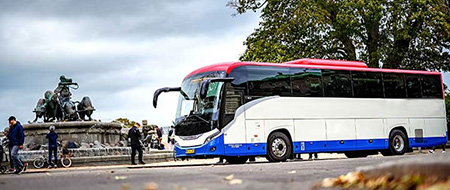
When Paul Aldridge, host of Australasian Bus & Coach TV, arranged a road test of the Yutong C12, the opportunity arose to experience two buses in one day. The C12 is diesel-powered, while its sibling, the C12E, is fully electric. Both share the same 12-metre body, providing an opportunity to compare two different powertrains on the same vehicle platform.
Here is Paul Aldridge’s experience and assessment of both models.
Behind the Wheel of the Diesel C12
Having never driven a C12 before, Aldridge was quickly impressed by the driver’s compartment. The switches are angled towards the driver, controls are integrated into the steering wheel, and everything needed for daily checks is positioned directly in front of the driver’s seat, without having to navigate through menus.
“Everything is at my fingertips.”
That was his verdict on the layout. The air conditioning has its own straightforward controls for temperature and fan speed, allowing the driver to adjust settings when passengers are too hot or too cold.
Pulling away from traffic lights, the C12’s 340 horsepower made itself felt. Aldridge noted that there was plenty of power and that carrying a full load of passengers would not be a problem.
Small Details That Make a Long Shift Easier
Many of the features Aldridge highlighted were practical details that drivers would appreciate throughout a long working day.
Electric blinds are within easy reach, while the driver’s window can be opened for fresh air or to reach out and adjust a mirror. Both exterior mirrors are electrically adjustable and heated, a feature Aldridge particularly welcomed.
The driver’s climate control system also received positive feedback. He noted the number of adjustable air vents around the driver’s position. As someone who gets cold feet, he particularly appreciated the two lower vents in the footwell, which deliver warm air during cold winter mornings.
Two small storage compartments on the dashboard provide space for water bottles for the driver or hostess, as well as brochures and flyers.
The 360-degree camera system, displayed on an LCD screen, particularly impressed him. During the test, it tracked a pedestrian along the driver’s side and around the rear of the bus.
“Every bus should now, in 2024 onwards, have this feature.”
The camera is part of a wider safety package that also includes an Advanced Driver Warning System, the TS160 door safety system, AEBS, ABS, ASR and ESC.
A Walk Through the Passenger Cabin
Inside, the C12 offers 1,920 mm of internal overhead height. Aldridge described the overhead storage compartments as robust and strong. While they are not designed for large suitcases, day bags and backpacks fit easily.
Two steps lead up to the rear of the bus, where the engine compartment is located below.
Every passenger gets a lap-sash seatbelt, a fabric seat and a fold-down armrest. Each seat also has its own overhead air vent and reading light. The vents feature adjustable settings, while USB ports are integrated into the seatbacks.
One drop-down TV screen comes as standard, with a second available as an option.
The C12 seats 53 to 57 passengers plus the driver.
For school transport, operators can specify 2-for-3 child seating, CCTV and an electronic destination sign. Charter and tour configurations can include reclining luxury coach seats, passenger window curtains and a fold-down LCD screen.
The C12 is also approved as a Category 4 bus by Transport for NSW.
Outside and Under the Skin
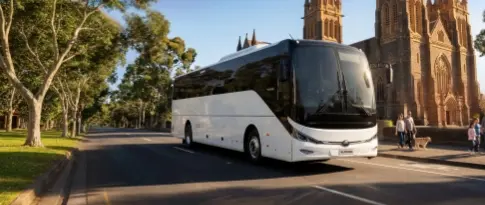
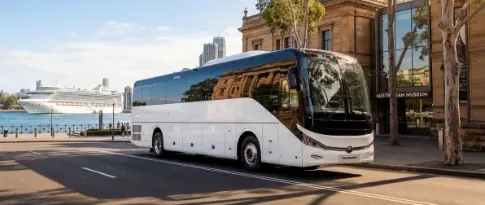
From the outside, Aldridge’s first impression was European, with sleek headlights and wraparound taillights.
Access doors on both sides provide access to the 400-litre diesel tank for servicing, washing or inspection. The full-through luggage compartments, featuring durable timber flooring, can safely carry up to 800 kg of luggage.
The three-piece bumper initially appears simple but proved to be one of his favourite practical features. If a corner is damaged, only the affected panel needs to be replaced rather than the entire bumper.
Power comes from a Cummins six-cylinder, 8.9-litre engine producing 340 horsepower and 1,600 Nm of torque. The belts, air conditioning compressor and daily inspection points are all easily accessible. The engine also meets Euro VI emissions standards.
On the road, Aldridge was impressed by the balance of the vehicle’s performance.
“It’s not overpowered. It’s not underpowered. I think it’s just right at the sweet spot.”
Switching to the Electric C12E
Next came the C12E.
Its battery system uses 10 packs, which Aldridge described as a 350-kilowatt system, protected by heavy vertical intrusion bars. Charging ports are positioned on both sides of the bus.
The batteries occupy some of the luggage compartment space, with the C12E offering approximately half a luggage bin less storage compared with the diesel version.
He also pointed out a nitrogen system designed to help in the event of a thermal event, a 24-volt system with an isolation switch, and a rear compartment housing the battery management system, power control unit and their cooling systems. Coolant levels are easily accessible for inspection.
The drive motor is rated at 150 kW, with a peak output of 350 kW during take-off, delivering 3,200 Nm of torque.
Regenerative braking can recover up to 350 kW. During the test, Aldridge could feel the regenerative braking system working as the bus slowed to 40 km/h while travelling through a country town.
“Going from the C12 to the C12E is night and day.”
The power steering allowed one-handed turning, and the bus demonstrated plenty of power at 80 km/h on country roads with inclines.
Without conventional engine noise, Aldridge described the cabin as feeling more solid and “very encapsulated”, making it well suited to day charter operations.
The Verdict
Aldridge’s assessment was clear. The diesel C12 is a versatile all-rounder, suited to charter services, long-distance operations, school transport and mining.
“The electric bus is on another level.”
Quiet, pleasant to drive and offering a different braking experience, the C12E retains the same exterior design as the diesel C12. The two buses look the same but deliver distinctly different driving experiences.
The review also included feedback from Australian operators.
Tropic Wings Cairns Tours commented on the C12: “Give me a Yutong any day and I’ll take it.”
MacArthur Anglican School also reported that its Yutong bus had never broken down during a run.
Discover the Yutong C12 and C12E
Watch Paul Aldridge’s full road test to learn more about the driving experience and features of the Yutong C12 and C12E.
For more information about Yutong buses and services in Australia, please contact the Yutong Australia team or VDI Australia, Yutong’s authorised distributor in Australia.
Previous News
-

November 10,2026
Not Using the Market as a Testing Ground | Inside Yutong’s Water Wading, Rain and High-Speed Track Tests -
November 06,2026
Yutong Showcases Electric Mobility Solutions for Diverse Operating Scenarios at Singapore SUMW 2026 -
October 28,2026
Yutong D7 Review: Behind the Wheel with Australian Bus & Coach
Subscribe Now
Get updates you care about.
Submit